
Deliberate Practice Guide
DOCX download
Deliberate Practice Guide
Free editable Word guide you can copy, fill in, and share with your band. Also readable on this page.
How to use this guide
Guide for implementing deliberate practice in rehearsals. Leave with a per-member targets sheet — weak skill, matching drill, tempo ladder, and a date to recheck it.
Suggested workflow: Every member names one weak skill, pairs it with a drill and tempo plan, and sets a review date. Keep the sheet with the setlist notes and rewrite it once a target skill clicks.
Repeating songs is not the same as improving. Deliberate practice targets weakness with feedback so rehearsal hours compound instead of plateau.
Isolation versus integration
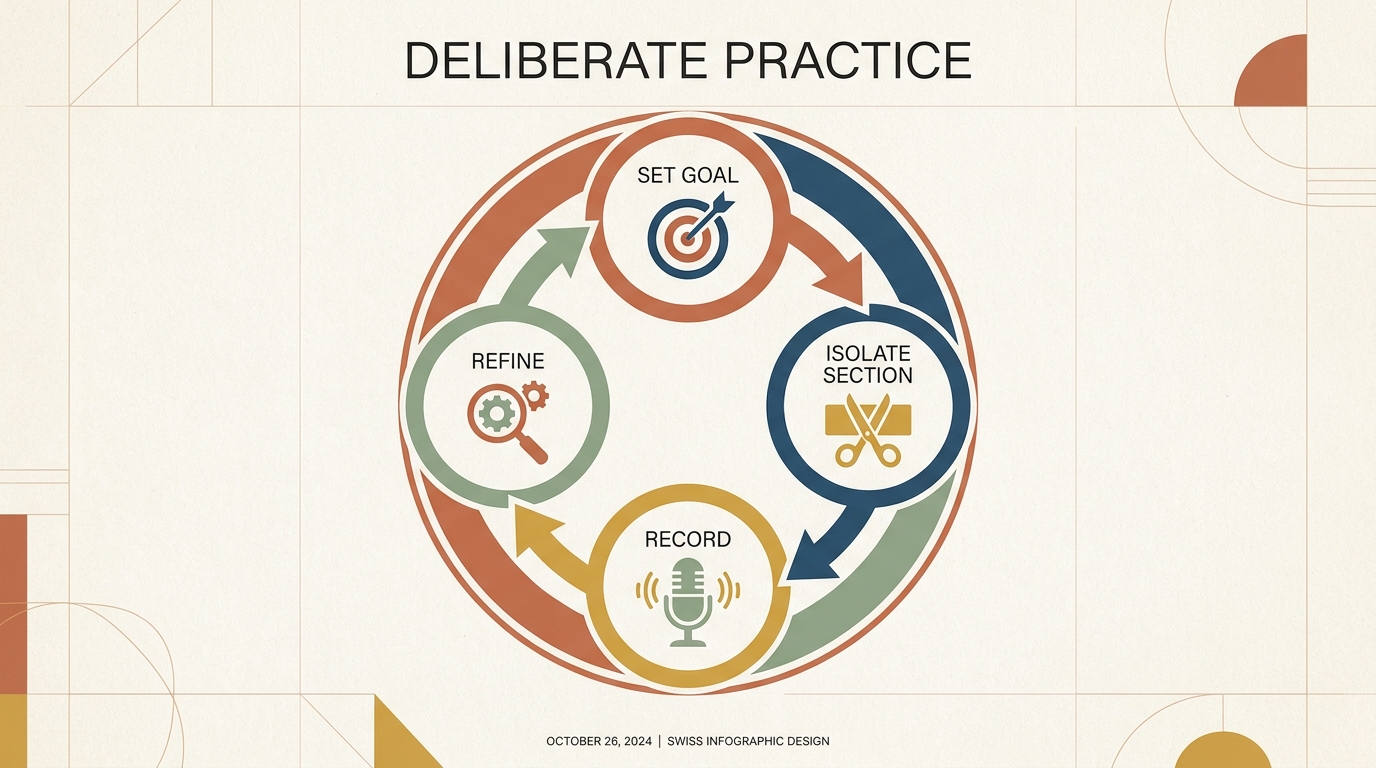
A flammed fill inside a full run-through stays flammed, because the song moves on before anyone can fix it. Pull the bar out, loop it slowly against a click, and only reinsert it once it holds three clean passes in a row at rehearsal tempo.
Full song runs are for stitching repaired parts back into the arrangement, and a developing band can spend about a fifth to two-fifths of room time on isolated work. Name the target out loud — time, dynamics, blend, transitions — because “the song feels off” gives nobody anything to work on.
Homework is where cheap gains live
A rehearsal room costing forty dollars an hour is the wrong place to learn what a metronome at home teaches free. Send each member out with one drill, a written definition of finished, and a tempo ladder like sixty to eighty BPM across the week.
Remote members can post a sixty-second phone video the night before, which turns “I practiced” into something checkable. When homework repeatedly never lands, treat it like an attendance problem and have the talk, instead of re-teaching the part every week at full room rates.
Feedback craft
Useful notes sound like “the chorus rush starts at bar three, so loop it against the click at seventy” — aimed at the part, delivered near the moment, and attached to a concrete exercise. Vague verdicts like “tighten up” give the player nothing concrete to rehearse at home.
Criticism with no next step teaches people to dread the pause between songs rather than improve. A leader who pairs every correction with one drill and a recheck date builds a room where mistakes surface early, which is exactly where you want them before a paying crowd hears them.
Fill-in: Practice targets
Weak skill: ________
Drill: ________
Tempo plan: ________
Review date: ________
Putting it into practice
Assign one home drill per member before the next full-band night.
FAQ
How is deliberate practice different from running songs?
It isolates a weak skill with feedback and repetition under focus. Full song runs are for integration, not for fixing a flammed fill.
How much of rehearsal should be deliberate practice?
Often 20–40% for developing bands. Show-sims still matter; pure isolation forever kills joy and set stamina.
Can deliberate practice happen at home?
Yes—and it should. Room hours are expensive for things a metronome can fix alone.
How do we give feedback without crushing people?
Specific, timely, about the part not the person, and paired with a drill. Vague “do better” is not feedback.