
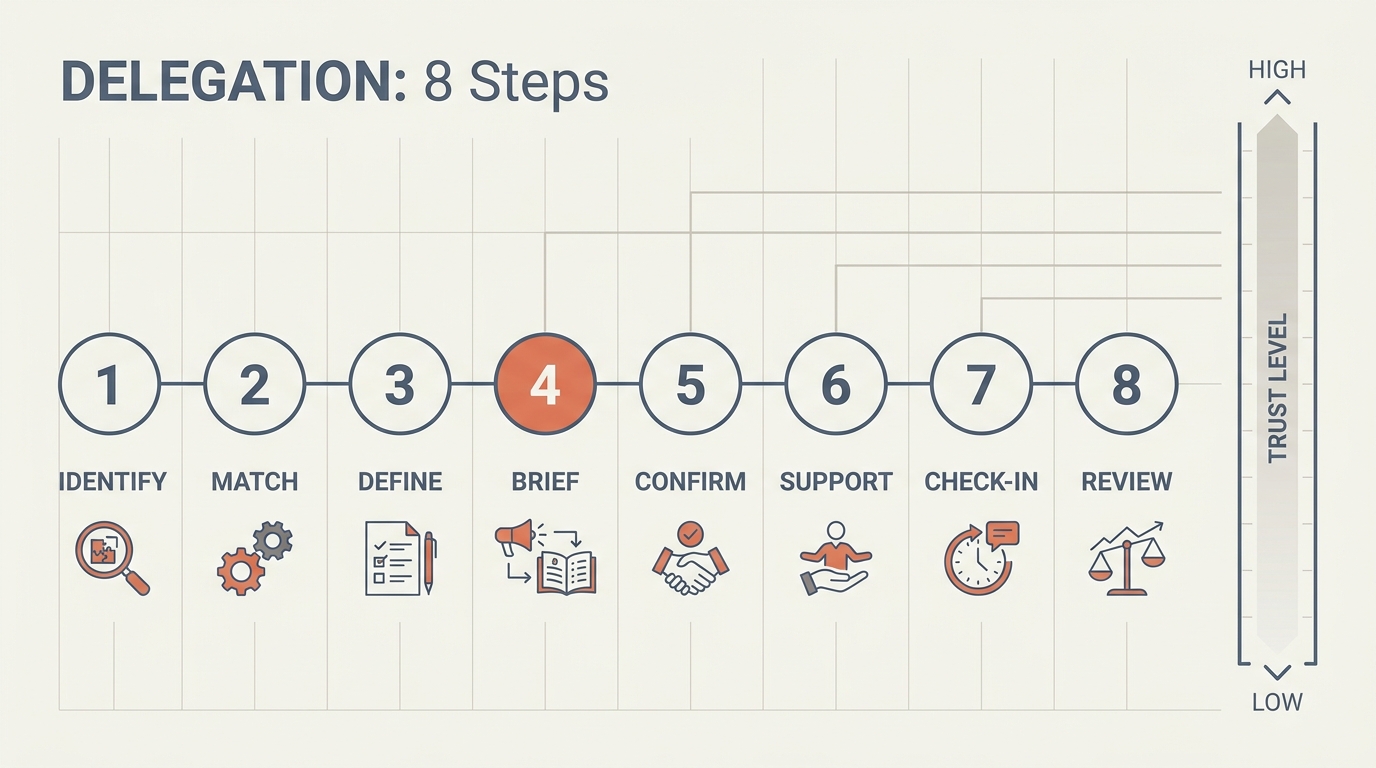
Delegation Framework
DOCX download
Delegation Framework
Free editable Word guide you can copy, fill in, and share with your band. Also readable on this page.
How to use this guide
Framework for effective delegation. You walk away with a delegation board: every recurring task carrying an owner, a definition of done, and a check-in date.
How to run it: List the band's recurring jobs, give each one an owner plus a written 'done means,' then set dues and check-ins. Pin the board wherever rehearsal planning happens and reassign any task that misses twice.
One person doing everything becomes a bottleneck and a burnout case. Delegation with clear specs is respect, not dumping.
Define done
Handing someone the merch table means spelling out what finished looks like: cash counted against the tally sheet, remaining stock photographed, and the card reader returned to the case. Include the deadline, the budget or logins they need, and one midweek check-in so problems surface early.
A bare “handle this” with zero context is dumping, and it trains people to fail. Recurring jobs like weekly social scheduling or monthly setlist printing only need the spec written once; after that, the same card moves between owners without a fresh explanation every time.
What stays centralized
A short list genuinely stays with one or two people: signing contracts, moving money above an agreed threshold, and anything safety-related at a venue. Those carry legal and bodily consequences, so concentrating that authority in one or two steady hands is caution rather than control.
Everything routine should rotate with a named owner per month — merch counts, file labeling in the shared drive, routine booking follow-ups. A leader who holds every small job is not leading; they are hoarding risk and guaranteeing that one sick week stalls the whole band.
Failure handling
The first missed handoff earns a coaching pass with sharper specs, usually a five-minute talk about what finished actually required of them. When the same job slips twice more, reassign it without a trial; a repeated pattern is information, not bad luck.
Quietly fixing someone's dropped task at midnight trains helplessness in them and resentment in you. Put every job on a visible board with one name beside it, because tasks that live only in a group chat have a way of belonging to nobody.
Fill-in: Delegation board
Task: ________
Owner: ________
Done means: ________
Due: ________
Check-in: ________
Putting it into practice
Delegate one recurring task with a written definition of done this week.
FAQ
What tasks should leaders never fully delegate?
Final safety/money authority may stay centralized, but most ops (merch table, social scheduling, file labeling) can and should rotate with clear ownership.
How do we delegate without dumping?
Define done, deadline, resources, and check-in points. Dumping is “handle this” with zero context.
What if someone fails a delegated task?
Coach once with clearer specs; reassign if pattern continues. Silent cleanup trains helplessness.
How do we track ownership?
A simple RACI-style list or task board beats memory. Put names next to jobs.