

Band Task Management: How to Actually Get Things Done as a Band
Bands are small businesses that don't act like it. Every working band has a hundred moving pieces at any given moment — confirming a gig, printing merch, updating the website, sending the venue a tech rider, recording next month's content, picking up the new bass strings, replying to the podcast that wants an interview, paying the studio invoice. Without a task system, half of these things fall through the cracks every month, and the band operates in a constant state of mild emergency.
Bands are small businesses that don't act like it. Every working band has a hundred moving pieces at any given moment — confirming a gig, printing merch, updating the website, sending the venue a tech rider, recording next month's content, picking up the new bass strings, replying to the podcast that wants an interview, paying the studio invoice. Without a task system, half of these things fall through the cracks every month, and the band operates in a constant state of mild emergency.
Task management for bands isn't about Asana or Monday.com or Notion's project management features. It's about having one shared place where every admin and creative task is tracked, assigned, and visible. A band of four people has roughly the same coordination overhead as a small team of four at any startup, but bands rarely treat it that way. They rely on memory, group chat, and good intentions. The result is predictable: missed deadlines, dropped balls, and the same conversations happening every month about the same things.
The minimum viable band task system has three views: a master list of everything the band needs to do, a per-person list of who's owning what, and a this-week view of what's due in the next seven days. Everything else is nice-to-have. The tool can be a shared Google Doc with checkboxes (it works for very small bands), a Notion database, Trello boards, or Bandmate's built-in task system — but the views matter more than the tool. If your bandmates can't see what's on their plate this week, the system has failed.
Task hygiene makes the difference. Every task needs an owner, a due date, and a clear definition of done. "Work on merch" is not a task — "Finalize the new t-shirt design with the printer by Friday" is. Tasks without owners drift indefinitely. Tasks without due dates get done eventually, which usually means too late. Tasks without clear definitions of done create arguments at the end. The discipline of writing tasks as actual tasks, not vague intentions, is what separates bands that ship from bands that talk about shipping.
Cadence matters more than volume. A weekly band admin meeting — 30 minutes, every Monday — where the team reviews the task list, assigns new work, and clears completed items, is the single highest-leverage habit a band can adopt. Bands that do this consistently get twice as much done as bands that operate by chaotic group chat. The meeting doesn't need to be in person — Zoom works, a group call works, even an asynchronous Slack thread with a structured agenda works. What matters is that it happens on a schedule and the task list is updated as a result.
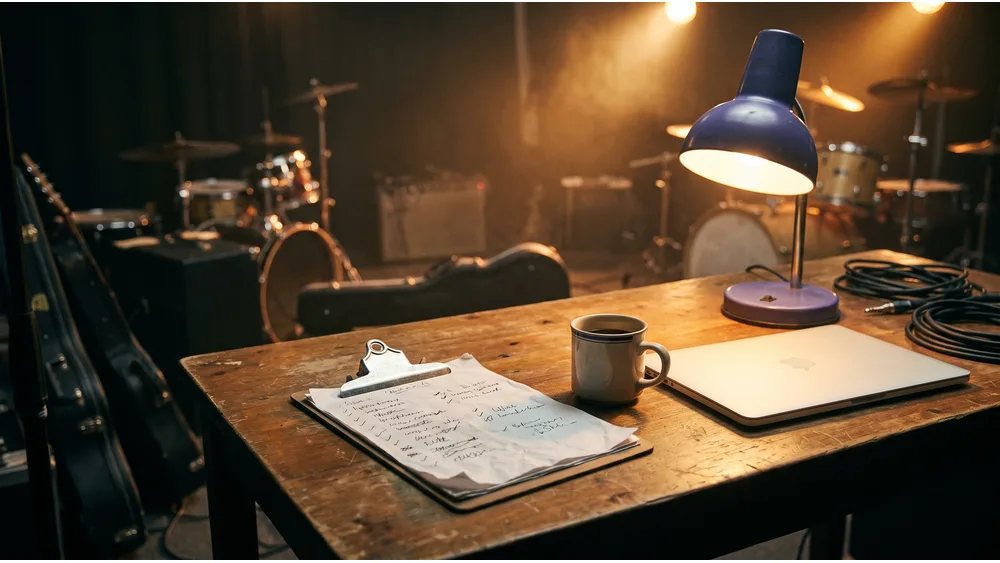
Avoid the over-engineering trap. Bands with five active tasks don't need a Gantt chart. Bands with fifty active tasks do need structure, but they don't need enterprise project management — they need a bandmate who actually maintains the task list. The single biggest predictor of whether a band's task system works isn't the tool, it's whether one person owns the discipline of keeping it clean. If no one owns it, the system rots within a month.
The categories that work for most bands: gigs (each show is a task cluster with prep, performance, follow-up), release coordination (studio time, mastering, artwork, distribution, promo), band operations (rehearsals, finances, admin), and growth (marketing, content, partnerships). Bands with active tours add a tour-prep category two months out from each tour. That's it. Don't subdivide further until the existing categories are overloaded.
The shift from chaos to system is the shift from "I thought you were handling that" to "I can see you're handling that." Once the task list is real and visible, accountability stops being a source of friction and becomes the default. Bandmates stop re-doing work someone else already did. They stop asking the same question twice. They stop dropping balls because the balls are visible.
Bandmate's task system is built into the band workspace — no separate app, no setup, just open the band and see what's on the plate this week. Free to try with up to a small band.

Founder of Bandmate ®, entrepreneur, and musician helping bands succeed in the modern music industry.
Band Social Media Strategy: Complete Guide for 2025
Venues still open Instagram before they open your email. If the grid looks dead, the pitch feels riskier—even when the music is strong. Social is not decoration; it is public proof that your band is active, bookable, and worth a room.
Band Tax Preparation Checklist: Everything You Need Before April
Band taxes don't have to be a nightmare. They become one because bands don't track the right things during the year, then scramble in March to reconstruct six months of receipts from memory and text threads. The fix is a 12-month tax preparation system, not a 12-day tax season panic. Here's the complete checklist for what to track, when to track it, and what to claim.