

Band Database Organization: Build a Searchable Music Industry Network
A band contact database is more than a list of names. It's a structured record of every relationship that matters to your music career — every venue booker, every promoter, every media outlet, every sponsor, every collaborator, every fan segment — and the metadata that lets you actually use that information. Most bands' "databases" are just contact dumps with no structure, which means they're unsearchable, unsegmentable, and basically useless once they hit about 80 contacts.
A band contact database is more than a list of names. It's a structured record of every relationship that matters to your music career — every venue booker, every promoter, every media outlet, every sponsor, every collaborator, every fan segment — and the metadata that lets you actually use that information. Most bands' "databases" are just contact dumps with no structure, which means they're unsearchable, unsegmentable, and basically useless once they hit about 80 contacts.
Disorganized contact management is one of the quietest career killers in music. It doesn't feel dramatic—just death by a thousand missed opportunities. You can't follow up with the venue that loved your set because you can't find their info. You email an outdated booking agent address. You forget who introduced you to that festival coordinator. Eventually you develop a reputation as the band that's hard to work with, even when the music is great.
The shift from list to database happens when you start storing structured fields, not just names and emails. Every contact needs the basics — name, organization, role, email, phone, social handles — but to become a real database you need additional fields that let you slice the data. Lead time (how far in advance do they book?). Payment range (what do they typically pay?). Genre fit (which of your styles do they book or program?). Last interaction date. Next action. These five fields, on top of the basics, transform a contact dump into a working database.
Create one centralized system—not three spreadsheets scattered across phones and napkins. One place every band member can access. When someone asks "who booked that venue last year?" anyone in the band should answer in 30 seconds. I don't care if it's Google Sheets, a CRM, or Bandmate—what matters is shared, current access.
Schema design matters more than tool choice. Most bands pick Notion or Airtable or Bandmate because they heard it was good, then dump everything into a single flat list with maybe a tag column. That's a list, not a database. A real schema has linked records — a contact is linked to a venue, which has its own record with capacity, location, and booking notes. A gig is linked to a venue and a promoter. A follow-up task is linked to a contact. When records link to each other, you stop storing the same info in multiple places, and updates propagate automatically.
Tag taxonomies are where most databases fail. Bands tag inconsistently — one contact gets "venue," another gets "club," another gets "live music venue," and now you can't filter by category. The fix is a controlled vocabulary: define your tags upfront, document what they mean, and never use a tag outside the list. For a band database, the canonical tag categories are role (venue, promoter, media, sponsor, fan, collaborator, agent), market (city or region), status (cold lead, warm lead, active, past), and genre-fit. That's it for v1. Resist the urge to add more categories until you've actually used the system for three months.
Within roles, capture operational intelligence: which venues pay well, which promote hard, which have great sound. That isn't busy work—it's the difference between a dump of names and a network you can actually run.
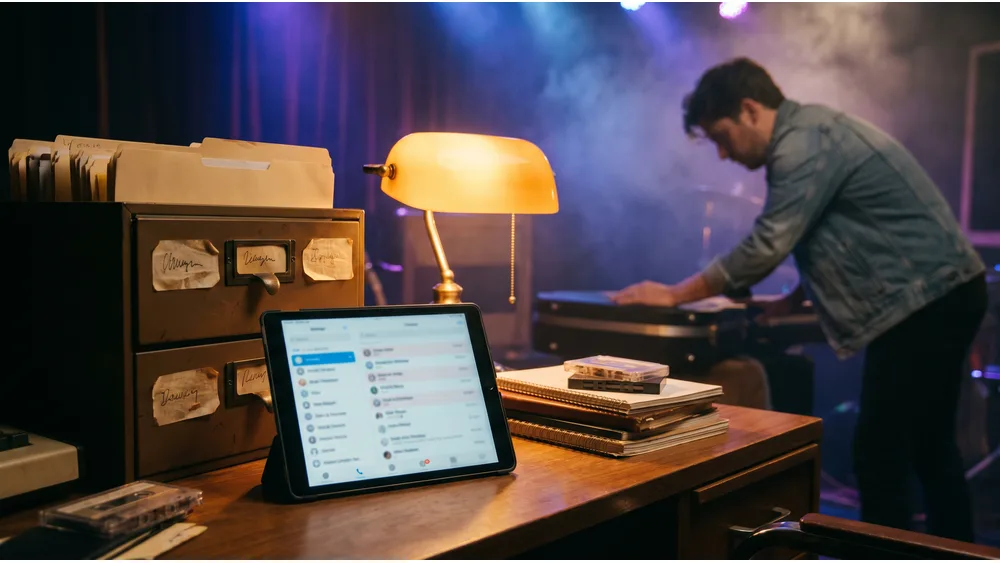
Workflow design is what makes the database a working tool rather than a graveyard. Every contact should have a next action — call, email, follow up in six months, drop from active list. Filter your database by next-action-due every Monday and you have a weekly pipeline. Filter by last-interaction-over-90-days and you have a re-engagement queue. These two views, applied weekly, are what separate bands that grow their network from bands whose networks decay.
Keep it current. Contact information decays faster than you think—people change venues, switch emails, move cities. Set a quarterly reminder to verify your top 20 contacts are still accurate. Nothing screams amateur like emailing someone who left their position six months ago.
Avoid the common traps. Don't try to migrate every contact from your phone on day one — start with your top 50 most important relationships and build from there. Don't over-customize the schema before you have real data — schemas evolve from use, not theory. Don't let the database become a solo project owned by one band member — share access, train the team, make it part of the band workflow or it will rot.
The real value of a well-organized band database compounds over years. By year two, you know which 12 venues book you repeatedly, which 5 promoters actually deliver audiences, which 8 media outlets move streams. By year five, your database is a competitive advantage that newer bands can't replicate quickly — you have institutional knowledge encoded into a system, not trapped in someone's memory.
Bandmate structures contacts as a proper database from day one — linked records, controlled tags, interaction logs, and pipeline views. No setup, no schema design, no migration headaches. Open the app and start building the network.

Founder of Bandmate ®, entrepreneur, and musician helping bands succeed in the modern music industry.
Band CRM vs Spreadsheets: Why Upgrading Beats DIY Every Time
Every band starts with a spreadsheet. Google Sheets, Excel, Airtable, Notion — same idea, different wrapper. A column for venue name, a column for booker, a column for email, maybe a column for last contact date. For the first fifty contacts, this works fine. For the next two hundred, it slowly turns into a junk drawer. By the time you have five hundred rows, you're afraid to touch it because one bad sort will destroy everything.
Band Document Storage: Where to Keep Contracts, Tax Docs & Recordings
Band document storage is one of those things bands don't think about until they need it. The hard drive fails the week before tax filing. The laptop gets stolen at a gig. The cloud account gets locked because someone forgot the password. The single copy of the recording session gets corrupted and nobody has a backup. Every one of these scenarios has happened to bands I know. The fix is thinking about storage as a system, not an afterthought.