

Band Rehearsal Scheduling Software: How to Stop the Weekly 'When Works?' Thread
The weekly "when are we rehearsing?" thread is one of the most reliable rituals in band life. Someone asks Sunday night, four people respond at different times across Monday and Tuesday, eventually a time emerges that only kinda works for everyone, the rehearsal gets scheduled for that time, and two people show up late because they forgot. Every band has this thread. Most bands have it every week. The fix is rehearsal scheduling software that handles the coordination automatically.
The weekly "when are we rehearsing?" thread is one of the most reliable rituals in band life. Someone asks Sunday night, four people respond at different times across Monday and Tuesday, eventually a time emerges that only kinda works for everyone, the rehearsal gets scheduled for that time, and two people show up late because they forgot. Every band has this thread. Most bands have it every week. The fix is rehearsal scheduling software that handles the coordination automatically.
What rehearsal scheduling software actually does. It centralizes every band member's availability in one place, surfaces when the whole band is free, lets you book a rehearsal slot that conflicts with no one, sends confirmations to everyone, and reminds the band 24 hours before. That's it. The tools that do this well turn a 14-message thread into a 30-second action. The tools that don't are worse than the thread because they add steps without removing them.
The features that matter. Shared availability where every band member marks when they're free (and when they're not). Conflict detection so the scheduling tool flags double-bookings. Automatic reminders to all bandmates the day before and the hour before. Mobile access because most scheduling decisions happen from a phone. Integration with the band's main calendar so confirmed rehearsals land alongside gigs and personal commitments. Recurring rehearsal support for bands that rehearse on the same day every week.
The features that don't matter. AI-powered scheduling optimization (overkill for a 4-person band). Time zone intelligence for international touring (most bands aren't touring internationally yet). Custom workflow builders (you don't need this). Pricing tier-based feature gates that lock basic scheduling behind a paid tier — basic scheduling should be free.
The category options. Dedicated scheduling tools (Doodle, When2Meet, Calendly) work for one-off coordination but lack band-specific context. Google Calendar with shared calendars works for very small bands and doesn't require a new tool — but the availability discovery is manual. Band-specific tools (Bandmate, BandHelper, GroupMe) have rehearsal scheduling tied to the band's broader workflow. The right choice depends on whether you want a separate tool for scheduling or want it integrated with the rest of your band management.
Google Calendar done right. Create a shared band calendar (everyone subscribes). Each bandmate keeps their personal calendar private but shares free/busy visibility. When scheduling a rehearsal, use the "Find a Time" view in Google Calendar to see when everyone's free. Create the rehearsal event in the band calendar with the date, time, location, and any notes. Everyone gets the invite automatically. This works for bands that already use Google Calendar and don't want a new tool. The downside: it requires everyone to keep their calendars up to date, which is a discipline problem more than a tool problem.
The discipline of availability. No scheduling tool works if bandmates don't maintain their availability. The minimum: every bandmate marks personal commitments (work, family, other gigs) in their calendar with privacy settings that share free/busy only. Bands that do this can schedule in minutes. Bands that don't can schedule in hours. If you can't get the band to maintain calendars, no scheduling tool will save you.
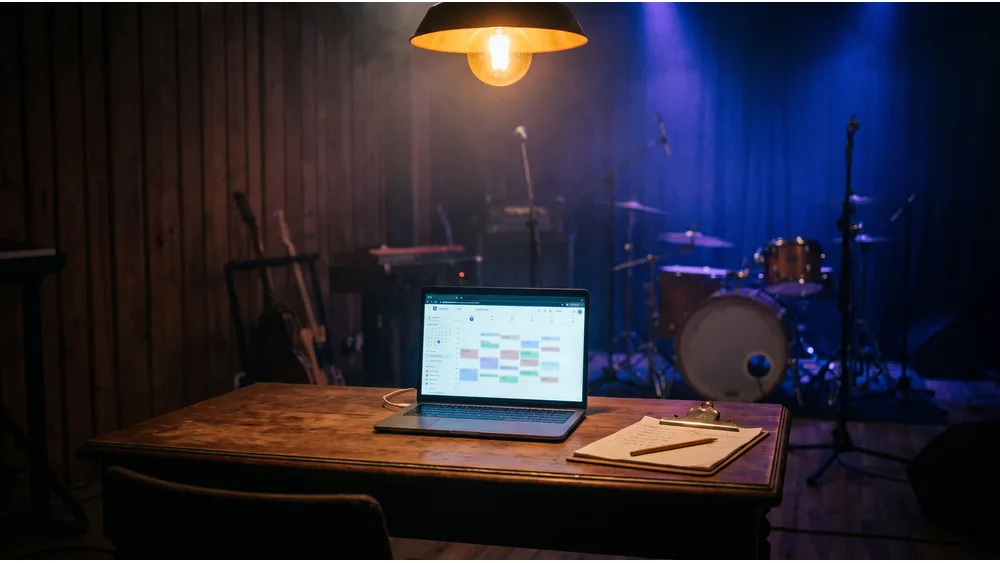
Recurring rehearsals vs ad-hoc. Most bands that rehearse regularly do it on a fixed schedule — every Tuesday at 7pm, or every Sunday afternoon. Set this up once as a recurring event in the band calendar, and 90% of your scheduling is done. Ad-hoc rehearsals (extra practices before a big gig, makeup sessions after a missed rehearsal) are the ones that benefit from scheduling software because they're harder to coordinate. If your band is mostly recurring, you might not need dedicated scheduling software at all.
The Monday weekly rehearsal confirmation. Even with the best tools, send a quick confirmation every Monday: "Rehearsing this Tuesday at 7pm at John's. Bring your gear." This takes 30 seconds and prevents the "wait, are we rehearsing this week?" question that always comes up Tuesday afternoon. Bands that do this confirmation ritual miss fewer rehearsals than bands that rely on the calendar alone.
Handling conflicts gracefully. Someone will inevitably have a conflict with the scheduled rehearsal. The fix is a clear protocol — who can call off rehearsal (the booking lead or a majority), how much notice is required (24 hours is fair), and what happens when rehearsal gets cancelled (does it get rescheduled or skipped?). Without a protocol, cancellations become contentious. With a protocol, cancellations are just operational.
Make rehearsal worth showing up to. The best scheduling software in the world doesn't fix the underlying problem if rehearsals feel like wasted time. If bandmates consistently skip or arrive late, ask why. Maybe the rehearsal isn't well-planned. Maybe the time slot is bad. Maybe the venue is inconvenient. Maybe the bandmate is checked out for reasons unrelated to scheduling. Fix the underlying issues and the scheduling becomes a non-problem.
The right tool removes friction. Spreadsheets and group texts are fine for two or three people but stop scaling past 4-5 active members with busy lives. Scheduling tools designed for groups (Doodle, Calendly) handle the coordination but lack band context. Calendar tools (Google Calendar, Outlook) work if everyone maintains them. Band-specific tools (Bandmate) tie rehearsal scheduling to the rest of the band management workflow.
Bandmate's rehearsal scheduling is built into the band workspace — shared availability, conflict detection, automatic reminders, recurring rehearsals, and integration with the band calendar. Free to try.

Founder of Bandmate ®, entrepreneur, and musician helping bands succeed in the modern music industry.
How to Create an EPK (Electronic Press Kit) for Your Band in 2025
Your EPK is often the reason a venue replies—or never opens your email again. Busy talent buyers compare acts in seconds on a phone between other jobs. They are not browsing for fun. They are answering one question: is this band a fit for my room, my night, and my risk tolerance?
Band Rehearsal Space: How to Find, Share, and Not Get Evicted
Bands die in bad rehearsal situations: noise complaints, stolen gear, mystery locks, and rooms so expensive nobody practices. Treat rehearsal logistics as part of the business, not an afterthought.