

Band Tax Preparation Checklist: Everything You Need Before April
Band taxes don't have to be a nightmare. They become one because bands don't track the right things during the year, then scramble in March to reconstruct six months of receipts from memory and text threads. The fix is a 12-month tax preparation system, not a 12-day tax season panic. Here's the complete checklist for what to track, when to track it, and what to claim.
Band taxes don't have to be a nightmare. They become one because bands don't track the right things during the year, then scramble in March to reconstruct six months of receipts from memory and text threads. The fix is a 12-month tax preparation system, not a 12-day tax season panic. Here's the complete checklist for what to track, when to track it, and what to claim.
The band structure matters first. Bands operating as informal partnerships (no formal entity, just people sharing money) usually report income on each member's personal return via Schedule C if they're a sole proprietor, or via partnership return (Form 1065) if they're a formal partnership. Bands operating as LLCs file as the entity type they elected — single-member LLCs default to sole proprietorship, multi-member LLCs default to partnership unless they elected corporate taxation. Bands operating as S-corps or C-corps file corporate returns. Get this wrong and the IRS notices. Most bands should be partnerships or LLCs taxed as partnerships — talk to a music accountant.
Income to track, regardless of structure. Every dollar that came into the band or to band members as a result of band activity: gig payments (the gross, before splits), merch sales (gross), streaming royalties (gross from each platform), publishing royalties (gross from your PRO), sync fees, sponsorships, session work done as the band, teaching or clinic fees paid to the band, and any band member contributions to cover expenses. Keep monthly statements from each platform — DistroKid, TuneCore, Bandcamp, your PRO, your payment processors.
Expenses to track, with receipts. Every deductible band expense needs a receipt and a category. Studio and recording (sessions, mixing, mastering, software). Gear and equipment (instruments, amps, pedals, computers used for music). Rehearsal space (rent, utilities if a dedicated space). Travel (mileage with a contemporaneous log, fuel, flights, hotels, per diems on tour days). Marketing (paid ads, PR, design, video, web hosting). Merch production (t-shirts, vinyl, stickers, posters — separate from merch sales income). Royalties and licensing (mechanical, sync, distribution platform fees). Administrative (accountant, lawyer, insurance, banking fees). Live performance costs (sound engineers, backline, venue hire when you're renting).
Deductions most bands miss. The home office deduction if you have a dedicated music workspace at home — the percentage of your home used exclusively for music, applied to your rent or mortgage interest, utilities, and home insurance. Mileage — every band-related trip tracked at the standard IRS mileage rate adds up to thousands per year. Health insurance premiums if you're self-employed as a musician. Professional development — conferences, courses, books, subscriptions directly related to your music career. Equipment depreciation for big purchases — that $4,000 guitar amp is depreciable over several years rather than fully deductible in the year of purchase, but Section 179 lets you deduct the full amount in year one up to annual limits. Retirement contributions — a SEP-IRA or Solo 401(k) for self-employed musicians lets you shelter significant income from current taxes.
Estimated quarterly taxes are not optional. If you expect to owe more than $1,000 in taxes for the year, the IRS requires quarterly estimated payments on April 15, June 15, September 15, and January 15. The amount is your projected annual tax divided by four. Bands that skip quarterly payments get hit with underpayment penalties in April. Bands that pay quarterly treat it as a non-negotiable band expense. The math: project your net income for the year (use last year as a baseline), apply your marginal tax rate plus self-employment tax (15.3%), divide by four, send it in.
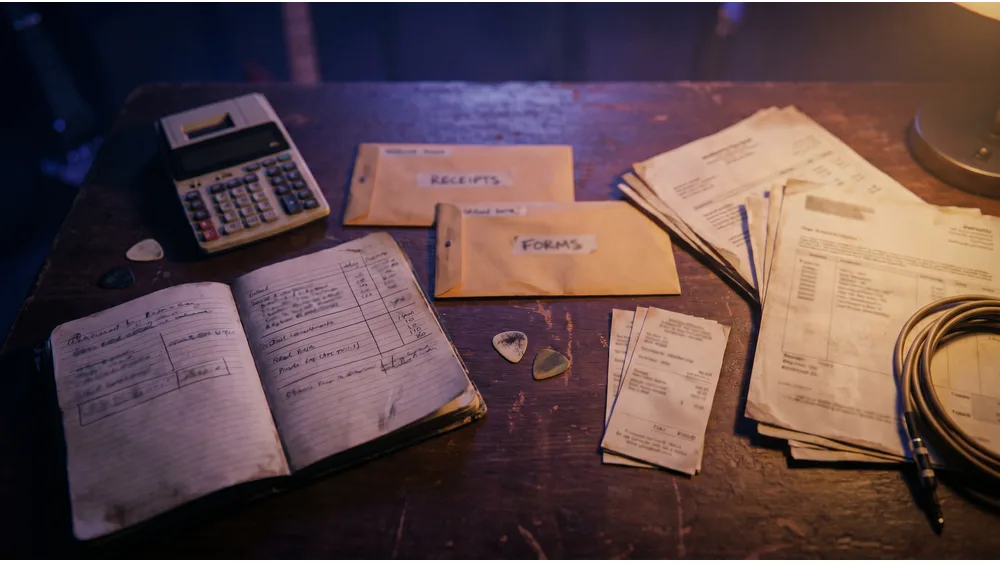
The monthly bookkeeping that makes April easy. Every month, do three things: log all income received, log all expenses paid, and reconcile against your bank statement. 30 minutes a month. Bands that do this spend maybe 4 hours total on tax prep in March. Bands that don't spend 40+ hours frantically reconstructing records and usually miss deductions worth hundreds to thousands of dollars.
Documents to gather in March before meeting your accountant. Year-end bank statements for all band accounts. Year-end statements from every income platform (DistroKid, Bandcamp, your PRO, your merch platform). A summary of all gig income (Bandmate or your tracker exports this). A categorized expense report with receipts. Mileage log for the year. Inventory of equipment purchased. Any 1099s or K-1s you received. Any contracts or major financial transactions from the year. Last year's tax return for reference.
When to hire a CPA. DIY taxes work for bands with simple finances (under $20K annual income, no entity, single state). Once you're over $20K, employing other people, operating in multiple states, owning gear that needs depreciation handling, or filing as anything other than a sole proprietorship, hire a music-focused CPA. They cost $500-2,000 per year and usually save more than they cost through deductions you'd miss alone. Ask other bands for recommendations — music CPAs understand the industry's quirks in ways general accountants don't.
Bandmate's tax reports export the year-end summary your accountant needs — categorized income and expenses, gig-by-gig payment history, and platform-by-platform royalty breakdowns. The monthly tracking feeds directly into the April prep. Free to try.

Founder of Bandmate ®, entrepreneur, and musician helping bands succeed in the modern music industry.
Band Task Management: How to Actually Get Things Done as a Band
Bands are small businesses that don't act like it. Every working band has a hundred moving pieces at any given moment — confirming a gig, printing merch, updating the website, sending the venue a tech rider, recording next month's content, picking up the new bass strings, replying to the podcast that wants an interview, paying the studio invoice. Without a task system, half of these things fall through the cracks every month, and the band operates in a constant state of mild emergency.
How to Build a Professional Band Website in 2025
Social platforms change their rules, bury your posts, and can vanish overnight. Your band website is the one URL you control: music, dates, booking contact, and press assets live in one place bookers and fans can find without hunting six apps. Building it well is less about pixel-perfect design and more about clear structure, fast load, and a finish line you actually cross.