
Shared Calendar for Bands: Stop the 'When Are You Free?' Text Thread
The text thread starts at 9pm on a Tuesday. "Hey when are we rehearsing this week?" Two hours later: "Thursday works for me." "Can't Thursday, gig Friday." "What about next Monday?" "Out of town Monday." By midnight the band has decided nothing and everyone is annoyed. This is how bands without shared calendars operate, and it's a productivity tax that compounds into missed rehearsals, double-bookings, and passive-aggressive group chat energy.
The text thread starts at 9pm on a Tuesday. "Hey when are we rehearsing this week?" Two hours later: "Thursday works for me." "Can't Thursday, gig Friday." "What about next Monday?" "Out of town Monday." By midnight the band has decided nothing and everyone is annoyed. This is how bands without shared calendars operate, and it's a productivity tax that compounds into missed rehearsals, double-bookings, and passive-aggressive group chat energy.
A shared band calendar is the single highest-leverage tool a band can adopt. It costs nothing, takes an hour to set up, and immediately ends 80% of the scheduling chaos. Every bandmate's availability is visible in one place, every confirmed gig is on the calendar the moment it's booked, every rehearsal gets scheduled and confirmed without a 40-message thread, and every bandmate gets notifications so nobody shows up to the wrong venue on the wrong day.
What you need from a shared band calendar is more nuanced than Google Calendar. You need layered visibility — bandmates see each other's free/busy but not necessarily personal appointments, gigs are visible to everyone including booked venues, rehearsals are band-only, and personal commitments stay private. You need mobile access because most schedule coordination happens from a phone. You need conflict detection so two gigs don't get booked for the same date. You need a way to mark tentative vs confirmed vs cancelled so the calendar reflects reality. Google Calendar handles the visibility piece but lacks the band-specific context. Bandmate builds all of this in. Apple Calendar shared calendars are serviceable for a duo or trio but get messy past four people. Fantastical and other premium calendar apps add features but still require manual coordination.
The setup that actually works: one master band calendar that everyone subscribes to, layered with each bandmate's personal calendar. The band calendar holds gigs, rehearsals, tours, and band-only events. Personal calendars stay private by default — bandmates share free/busy only. The benefit is that scheduling a rehearsal means checking when the band is collectively free, not when everyone has time to read 50 messages. Apple Calendar, Google Calendar, and Bandmate all support this pattern.
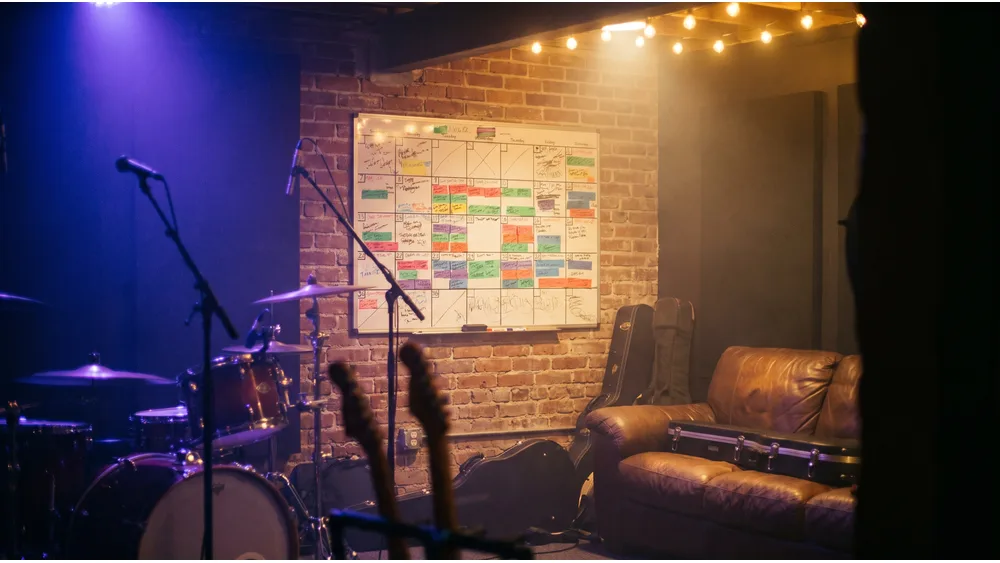
The disciplines that make it work: update the calendar immediately when a gig is booked, not "later." Mark rehearsals as tentative until everyone confirms. Use color coding so the band calendar is scannable — gigs one color, rehearsals another, tours a third. Set a default notification lead time of 24 hours for gigs and 4 hours for rehearsals. Review the week ahead every Sunday so nobody is surprised on Monday.
Avoid the common failure modes. Don't use a single personal Google Calendar that one person "owns" — the moment that person leaves the band, the calendar goes with them. Don't try to coordinate rehearsals in the calendar without a fallback communication channel — sometimes you need a quick group text, the calendar just shouldn't be the bottleneck. Don't overload the calendar with personal events — bandmates tune out calendars that mix too much non-band noise.
The real benefit of a shared band calendar isn't scheduling. It's trust. When bandmates can see each other's commitments and the band's commitments in one place, they stop assuming the worst ("he didn't show because he doesn't care") and start seeing the reality ("he didn't show because he had a work conflict he flagged two weeks ago"). That shift, repeated across a year, is what holds bands together.
Bandmate's shared calendar was built specifically for bands — layered visibility, conflict detection, mobile-first, and direct integration with the booking pipeline so confirmed gigs land on the calendar the moment they're booked. Free to try.

Founder of Bandmate ®, entrepreneur, and musician helping bands succeed in the modern music industry.
Session Musicians: How to Hire (and Get Hired) in 2026
Session musicians make records and stages work when a core band cannot cover every part—or when a project is built in the studio first. Whether you are hiring or looking for paid chairs, the difference between a smooth session and a disaster is usually the brief, the files, and the professionalism—not mystical talent alone.
So, You Want to Start a Band? Follow These Steps!
Starting a band is one of the best decisions a musician can make and one of the easiest to botch. Chemistry, songs, and ambition matter—but most new projects stall because nobody clarified the project, hired for reliability, or put a few boring systems in place before printing shirts.