
Conversation Starters
DOCX download
Conversation Starters
Free editable Word guide you can copy, fill in, and share with your band. Also readable on this page.
How to use this guide
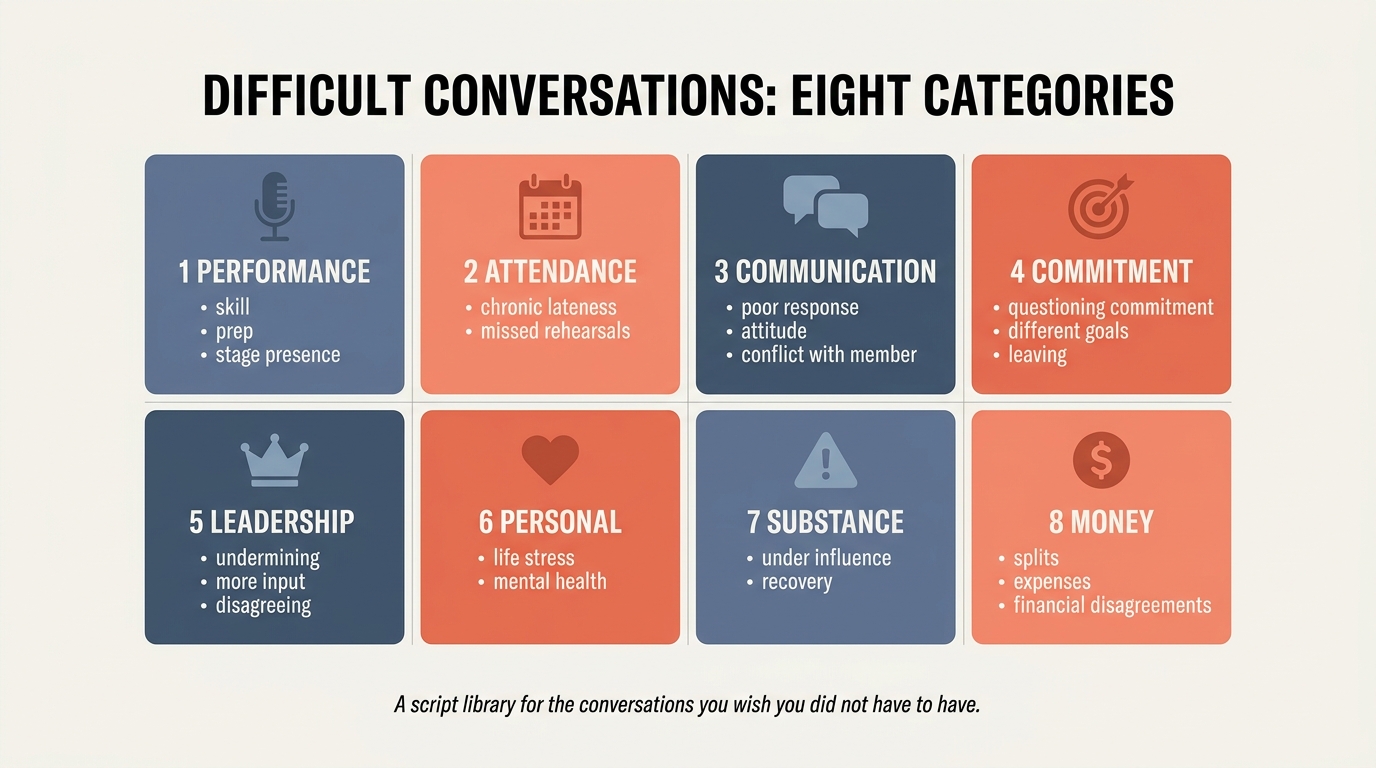
Conversation starters for difficult discussions. Leave with two rehearsed openers — one per live topic — that name the subject, the impact, and an invitation.
Write your Topic A and Topic B openers in the blanks, say each aloud once, and keep the page handy until both talks have happened; rewrite it when the next hard subject appears.
Opening lines matter. Hinting is not kindness. Name the topic early so people can respond to reality instead of decoding sighs.
When starters beat formal meetings
A clean opening line fits early, low-stakes friction: a drummer rushing the choruses, a vocalist skipping promo posts, gear left moldering in the van overnight. Repeated patterns, money restructuring, and exits deserve a planned sit-down with notes, and confusing the two containers causes overreaction in one direction and drift in the other.
Should the same casual line fail twice with zero shift in behavior, treat that as your signal to move into a planned meeting rather than deploying a third passive-aggressive joke at rehearsal. The hints were already delivered; what remains is a real agenda and forty honest minutes.
Clean openers
Name the subject, the impact, and an invitation in a single breath: “I want to talk about Saturday call times, because losing that hold cost us the spring series, and I want your read on it.” One sentence like that outperforms three weeks of heavy sighs over the setlist.
Skip character labels entirely and stay with observable behavior plus shared goals, because “you never pull your weight” opens a trial while “the van got unloaded by the same two people all month” opens a fix. Rehearse the line aloud once in the car, since awkward honesty lands far better than polished avoidance.
If they shut down
When someone goes silent or leaves the room, offer a pause plus a precise resumption point: take twenty minutes, and we finish this at 8:40 before load-out. An open-ended “whenever you feel ready” quietly becomes never, and resentment compounds in the gap like interest on van debt.
Chronic shutdown around every hard subject is fitness data about collaboration, not a personality quirk the rest of you should route around forever. A band runs on frequent uncomfortable talks, and a member who refuses them all eventually forces a choice between their comfort and the group's survival.
Fill-in: Openers we will use
Topic A opener: ________
Topic B opener: ________
Putting it into practice
Practice one clean opener before the next hard talk.
FAQ
When is a conversation starter better than a formal meeting?
For early, low-stakes concerns and relationship maintenance. Formal meetings fit repeated patterns, money changes, or exits.
How do we avoid sounding passive-aggressive?
Name the topic in the first sentence, state impact, and invite their view. Hinting is not kindness.
Should these talks happen after drinks?
Prefer sober, private, scheduled time. Alcoholic honesty is not a band system.
What if they shut down?
Offer a pause and a specific follow-up time. Chronic shutdown during hard topics is a fitness signal for collaborative work.