
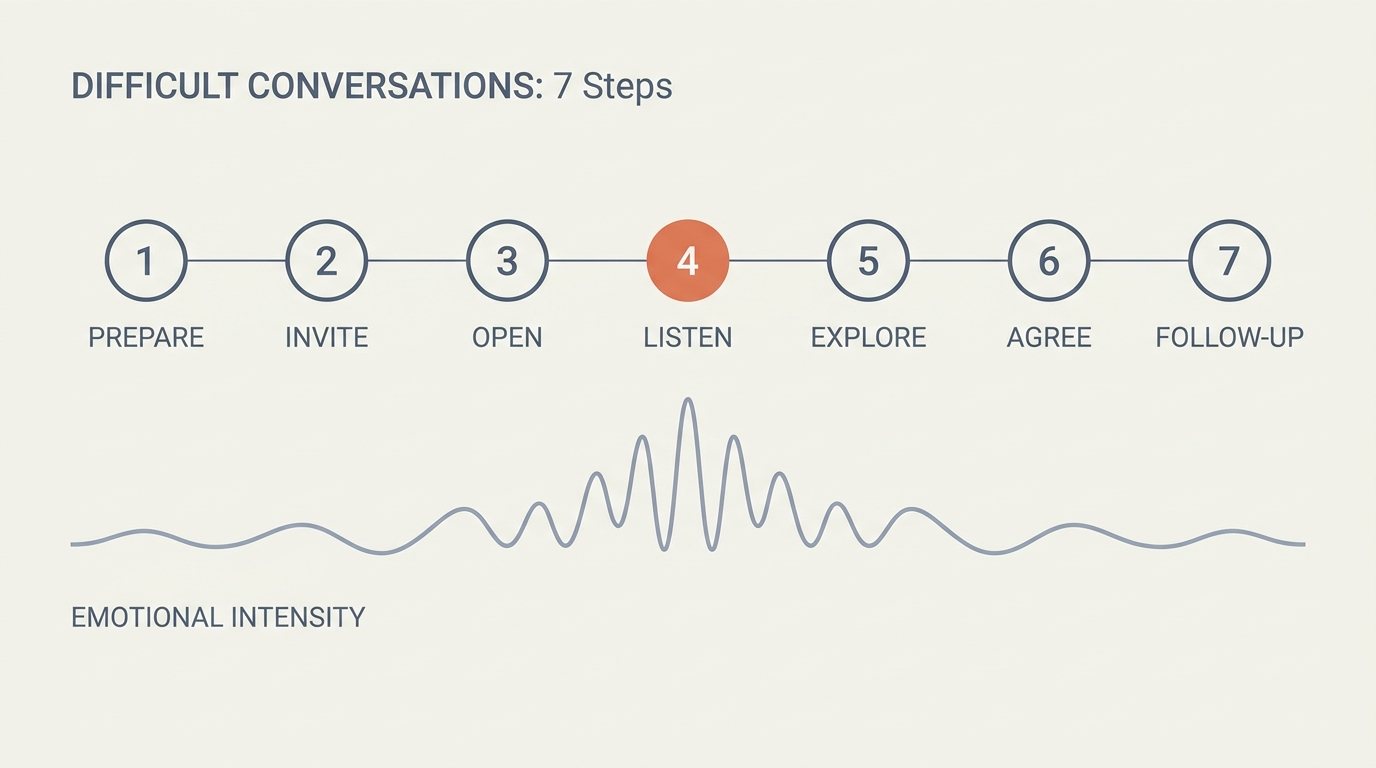
Difficult Conversations Guide
DOCX download
Difficult Conversations Guide
Free editable Word prep card you can copy, fill in, and share with your band. Also readable on this page.
DOCX download
Disengagement Notes
Diagnostic fill-in for patterns, curiosity conversation, reset plan, and review date.
DOCX download
Departure Conversation Plan
Private run sheet for exits: decision in one sentence, logistics, who attends, follow-up owner.
How to use this guide
Guide for navigating difficult conversations—including coaching talks, disengagement resets, and member exits. Come away holding a one-page prep card with your desired outcome, your opening line, and the logistics you might need. Use the disengagement and departure downloads when the situation is diagnostic or terminal rather than a one-off talk.
Prep ritual: Fill the four blanks the night before — topic, desired outcome, opening line, logistics — and bring only that card into the room.
Necessary talks delayed become explosions. Money, skill gaps, and behavior deserve scheduled honesty before the calendar forces a crisis.
Prepare before you speak
Know three things cold before you open your mouth: the outcome you want, the facts you can stand behind, and the one or two points you will not trade away. Rehearse your first sentence word for word, but leave their side of the script unwritten.
Timing is preparation too — a private, sober hour beats the stage wing between sets or the van ride after drinks. When gear, pay, or show dates are tangled into the issue, write those numbers down beforehand so emotion cannot erase the checklist mid-talk.
During the conversation
Lead with impact rather than verdict: “the last three load-ins started forty minutes late” lands better than “you are unreliable.” Then stop talking and hear their side, because a talk where only one person speaks is a sentencing, not a discussion anyone can grow from.
When the outcome is already settled, repeat it calmly rather than re-running the entire trial history in one sitting. If the room turns unsafe or someone stops functioning, end it and resume later with support instead of pushing through to a bad finish.
After the conversation
Send the agreed next steps in writing the same day, while both sides remember the same meeting clearly. An unwritten “we talked” becomes two competing memories within a week, and the second round of the fight is always about who said what.
Follow through on the mechanical fallout immediately: rehearsal calendar updates, changed shared-drive access, edited pinned posts, and lineup photos if the outcome affects the public. Administrative lag reads as indecision, and indecision invites everyone to quietly reopen a matter you already closed together.
When the issue is disengagement
Checked-out presence—phones, no prep, zero initiative—is a pattern, not a mystery. Hope is not a strategy, and silence trains the pattern to continue.
The tells are boring and cumulative: chronic lateness, prep that never happens, sarcasm whenever goals come up, and a quiet vanishing from unglamorous work like loading the van or updating the spreadsheet. One rough week is a human being having a life; six in a row is data. Jot observations with dates as they happen—three missed homework deadlines across March reads differently than a vague sense of drift.
Open with private curiosity rather than a verdict: is this a divorce, a day-job crunch, lost fit with the setlist, or a conflict nobody named? Attach a window—say, four rehearsals—and describe what re-engaged looks like in observable behavior: parts learned before the room, phone away, one volunteered task per week. Real reversals happen with role changes, schedule relief, or sharper goals. After a clear window with no movement, high impact plus low ownership is the signal to start planning an exit, kindly and promptly.
When the issue is departure
Removing or releasing a member by text is how bands create enemies and scene drama. A prepared conversation is still hard—and still kinder and cleaner for logistics and reputation.
Before anyone sits down, settle four things on paper: what was decided, the reasons you can say calmly without editorializing, the logistics of gear, booked shows, and owed money, and what the end state looks like. A final call delivered as an open debate is cruelty dressed as courtesy. Meet face to face, or on live video when distance is real, in a neutral place with a hard end time—forty minutes beats a three-hour autopsy. Where power is imbalanced, a witness both sides trust keeps the account honest.
Send a short written summary of next steps before the day ends: last show date, gear pickup, payout timing. Gather the remaining members once for one honest debrief, then close the topic as a standing agenda item. Update the calendar, pinned posts, and EPK lineup that week. Transition planning starts immediately: who covers the harmony parts, whether booked dates need a dep, and what the audition timeline looks like.
Fill-in: Conversation prep
Topic: ________
Desired outcome: ________
Opening line: ________
Logistics if needed: ________
Fill-in: Disengagement notes
Patterns: ________
Conversation date: ________
Reset plan: ________
Review date: ________
Fill-in: Departure conversation plan
Decision in one sentence: ________
Logistics to cover: ________
Who attends: ________
Follow-up written by: ________
Putting it into practice
Schedule one overdue conversation within seven days. If disengagement is visible, book a curiosity conversation this week. If an exit is decided, schedule the conversation within a week and complete logistics the same day.
FAQ
How do we prepare for a difficult conversation?
Clarify the outcome you want, the facts, and your non-negotiables. Script the opening; do not script their personality.
Where should it happen?
Private, neutral, sober, with enough time. Not the stage wing mid-set.
What if they get defensive?
Return to impact and specifics. End if safety is gone; resume later with a mediator if needed. See the conflict resolution framework when a neutral third party is required.
Should another member attend?
For power-balanced or sensitive exits, a witness can help. For coaching talks, one-to-one is often better.
What are early signs of disengagement?
Chronic lateness, no homework, sarcasm about goals, and disappearing from non-glam work. Patterns matter more than one bad week.
Can disengagement be reversed?
Sometimes with role changes, time off, or clearer goals. It cannot be reversed by pretending not to notice. Exit is right when impact stays high and ownership stays low after a clear reset window.
Should we ever remove someone by text, email, or group chat?
Almost never. Do it in person (or video if distance is real), privately, and with a clear reason. Written-only exits amplify shame and drama; use text only when safety requires distance or they refuse to meet.
How much notice should a departing member get before their last show?
Enough to finish agreed gigs and hand off parts without sabotaging the calendar—often one to a few rehearsals, not a months-long limbo. If behavior is toxic or unsafe, shorten the transition and protect the room. Write the last date in the conversation itself.
What should we say publicly after someone leaves the band?
Keep it brief, consistent, and non-detailed: gratitude for their time, a clean last date, and focus on the next chapter. Do not air attendance scores or personal conflicts. Align the internal message with the external one so members do not freestyle online.
Does this guide replace a written band agreement or legal advice?
No. Scripts help you communicate humanely; they do not settle IP, LLC membership, unpaid loans, or employment status. Use your band agreement and contract resources, and consult a qualified professional in your jurisdiction for high-stakes exits.