
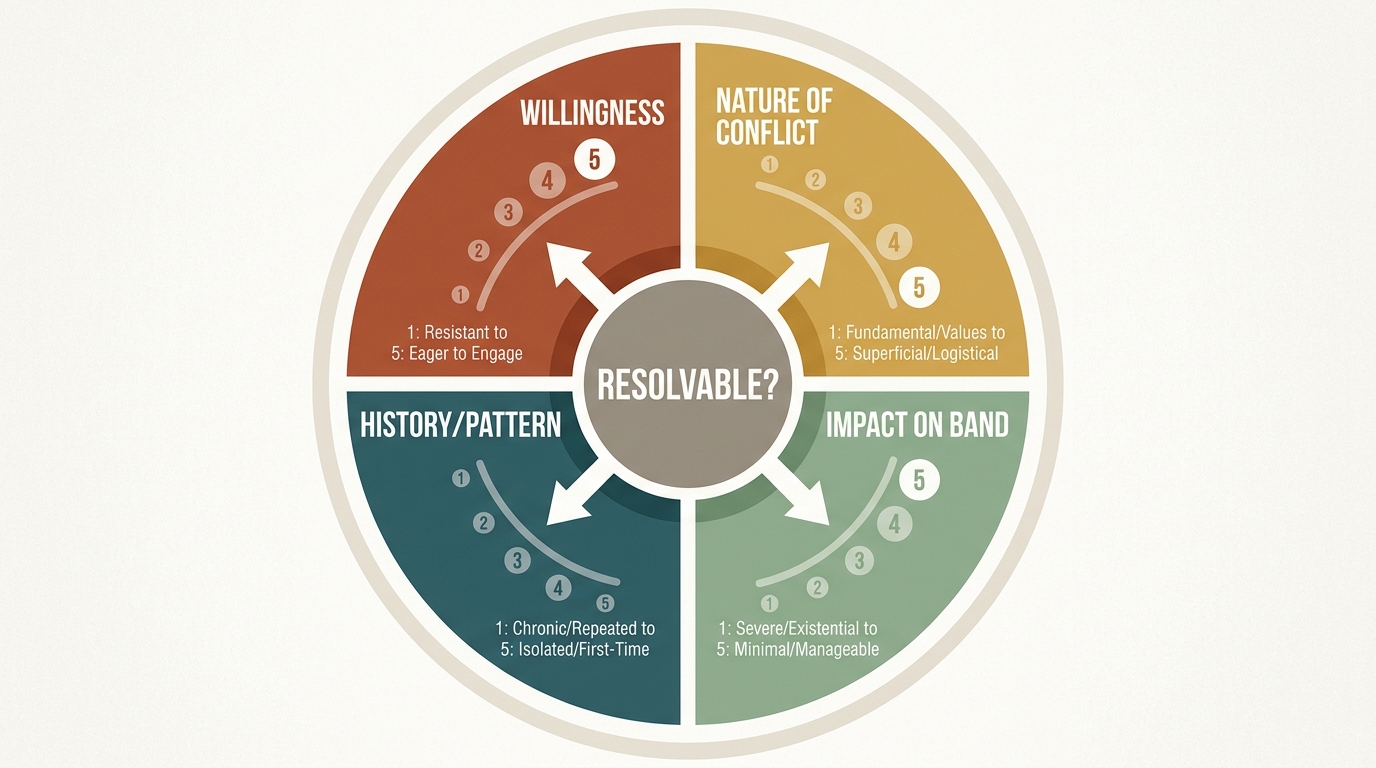
Resolvability Assessment Tool
DOCX download
Resolvability Assessment Tool
Free editable Word guide you can copy, fill in, and share with your band. Also readable on this page.
How to use this guide
Tool for assessing whether conflicts are resolvable. The page should end in a verdict: a time-boxed experiment worth trying, or an honest stop.
Reach for this check only when a fight has looped twice: answer the shared-interest and ownership questions, write one experiment with a stop date, and keep it private until decided.
Not every conflict should get another workshop. Assess whether repair is realistic before you spend another month in the same loop.
Resolvable signals
A feud between the guitarist and the singer is worth repairing when both still want the band to exist, both admit some behavior has to change, and a concrete agreement path exists, like splitting lead vocal duties by song. Missing any of those three, another talking circle mostly produces better stories about the fight.
The practical test is whether each side can name a two-week trial they would genuinely attempt, such as the drummer texting before rather than after a missed session. Vague promises to communicate better are not a trial; a trial has a behavior, an owner, and a check-in day.
Unresolvable soon
Some conflicts should not get a third workshop: open contempt in front of crowds, anything touching physical safety or harassment, or a flat refusal to admit the other person’s experience. Those call for boundaries or an exit conversation, and protecting the people affected outranks protecting the lineup.
Even promising repairs need an end point, because processing can quietly become the band’s main activity while songs and gigs wait. Choose a calendar day by which the trial is judged, and honor it; a fight entering its fourth month with no behavior change has already given you the answer.
Who decides
The call belongs to the people directly affected, helped by a mediator if one is involved, rather than whichever member tells the most compelling version at the bar afterward. A charismatic narrator can keep a doomed conflict alive for months simply by winning every retelling.
Putting the conclusions on paper, dated and shared with everyone, stops history from being quietly rewritten between meetings. When March’s agreement is on record, nobody can claim in May that they never promised to stop booking rehearsals on the drummer’s exam weeks that semester.
Fill-in: Resolvability check
Shared interest?: ________
Ownership present?: ________
Experiment: ________
Stop date: ________
Putting it into practice
If you are looping the same fight, run this assessment once and honor the stop date.
FAQ
What makes a conflict resolvable?
Shared interest in continuing, willingness to change behavior, and a concrete agreement path.
What makes it unresolvable soon?
Contempt, safety issues, or total denial of impact. Those need boundaries or exits, not more workshops.
How long should we try?
Set a time-bound repair plan with check-ins. Endless “processing” without behavior change is a holding pattern.
Who decides resolvability?
People affected plus any mediator—not only the loudest storyteller.