
productivity

Time-Boxing Template

Template for time-boxing rehearsal activities

Time-Boxing Template

Time-boxing prevents activities from expanding to fill all available time. This template helps you allocate time intentionally.

What is Time-Boxing?

Time-boxing:

  • Allocate fixed time to activities
  • Start and end on schedule
  • Move on when time's up
  • Prevents endless discussions

Without time-boxing:

  • Activities expand indefinitely
  • Lose track of time
  • Don't accomplish goals
  • Inefficient rehearsals

Why Time-Box?

Benefits:

  • Stay on schedule
  • Accomplish more
  • Maintain focus
  • Prevent perfectionism
  • Create urgency
  • Better time management

Without it:

  • Waste time
  • Get stuck
  • Don't finish
  • Frustration
  • Inefficiency

Time-Boxing Principles

1. Set Clear Time Limits

Be specific:

  • Not: "Work on song"
  • Yes: "Work on song for 30 minutes"

2. Stick to the Schedule

When time's up:

  • Stop
  • Move to next activity
  • Don't extend (usually)

3. Build in Buffer

Add buffer time:

  • Things take longer than expected
  • Need transition time
  • Allow flexibility

Rule of thumb:

  • Plan for 80% of time
  • Leave 20% as buffer

4. Prioritize Activities

Most important first:

  • Do critical items early
  • When energy is high
  • Before time runs out

Time-Boxing Template

Rehearsal Information

Date: _______________ Start time: _______________ End time: _______________ Total duration: ___ hours (___ minutes)


Time-Boxed Schedule

Setup & Sound Check

  • Time: 7:00 - 7:10 PM
  • Duration: 10 minutes
  • Goal: Ready to play

Check-In

  • Time: 7:10 - 7:15 PM
  • Duration: 5 minutes
  • Goal: Review goals and agenda

Activity 1: Name

  • Time: 7:15 - 7:45 PM
  • Duration: 30 minutes
  • Goal: _______________
  • Approach: _______________

Activity 2: Name

  • Time: 7:45 - 8:15 PM
  • Duration: 30 minutes
  • Goal: _______________
  • Approach: _______________

Break

  • Time: 8:15 - 8:25 PM
  • Duration: 10 minutes
  • Goal: Rest and recharge

Activity 3: Name

  • Time: 8:25 - 8:50 PM
  • Duration: 25 minutes
  • Goal: _______________
  • Approach: _______________

Wrap-Up

  • Time: 8:50 - 9:00 PM
  • Duration: 10 minutes
  • Goal: Review and plan next steps

Total productive time: 90 minutes Total break time: 10 minutes Setup/wrap time: 15 minutes Buffer: 5 minutes


Example Time-Boxes

2-Hour Rehearsal (Learning New Material)

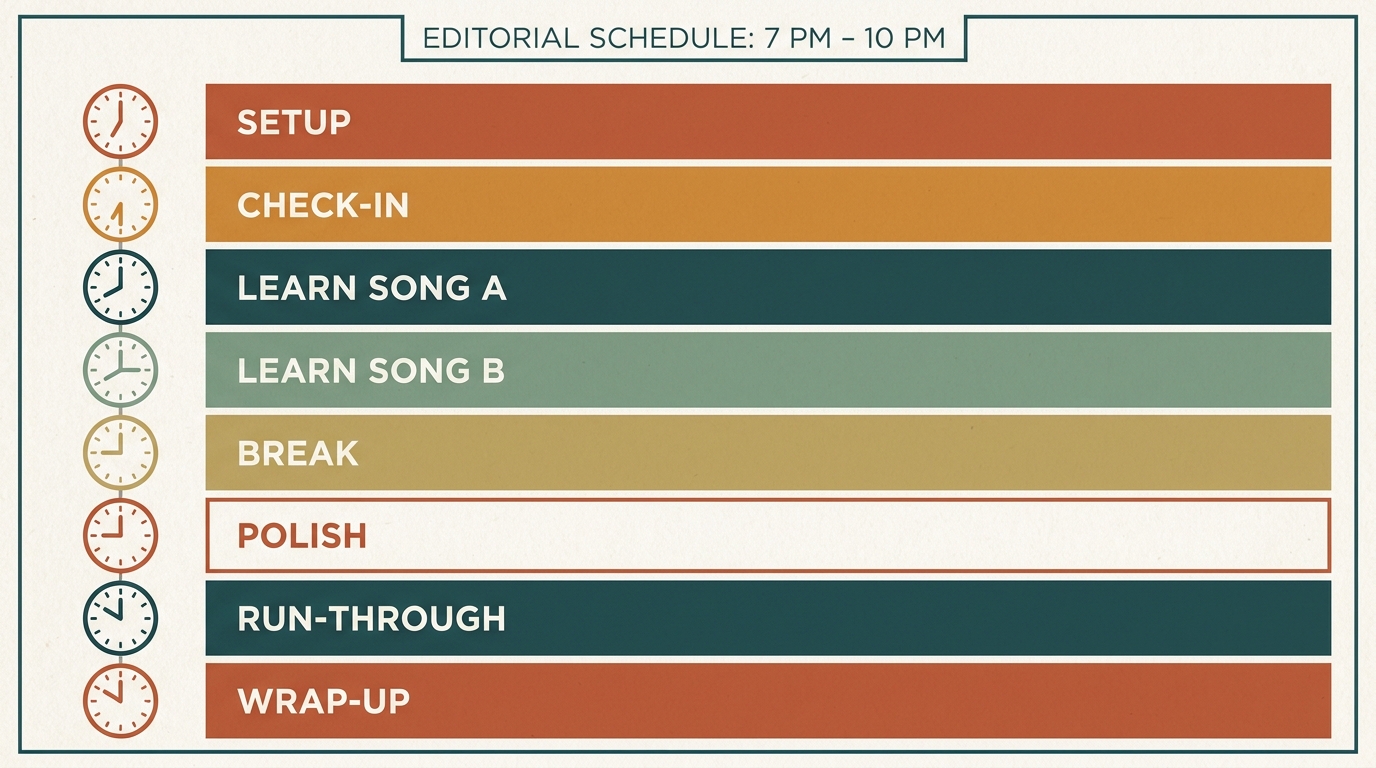
7:00-7:10 (10 min): Setup 7:10-7:15 (5 min): Check-in 7:15-7:45 (30 min): Learn verse and chorus of Song A 7:45-8:15 (30 min): Learn bridge and outro of Song A 8:15-8:25 (10 min): Break 8:25-8:50 (25 min): Play through Song A, identify issues 8:50-9:00 (10 min): Wrap-up and assign practice


3-Hour Rehearsal (Polishing for Show)

7:00-7:10 (10 min): Setup 7:10-7:15 (5 min): Check-in 7:15-7:55 (40 min): Polish Song 1 7:55-8:35 (40 min): Polish Song 2 8:35-8:50 (15 min): Break 8:50-9:25 (35 min): Run through full setlist 9:25-9:50 (25 min): Work on problem areas 9:50-10:00 (10 min): Wrap-up


4-Hour Rehearsal (Mixed Activities)

1:00-1:15 (15 min): Setup 1:15-1:20 (5 min): Check-in 1:20-2:10 (50 min): Learn new song 2:10-3:00 (50 min): Polish existing song 3:00-3:15 (15 min): Break 3:15-4:00 (45 min): Creative/writing session 4:00-4:45 (45 min): Run through setlist 4:45-5:00 (15 min): Wrap-up


Time-Boxing by Activity Type

Learning New Material

Recommended time-box: 30-50 minutes per song

Structure:

  • 10 min: Listen and discuss structure
  • 20 min: Learn section by section
  • 15 min: Play through
  • 5 min: Identify what needs work

Polishing Existing Material

Recommended time-box: 20-40 minutes per song

Structure:

  • 5 min: Play through, identify issues
  • 25 min: Work on problem areas
  • 10 min: Run through multiple times

Running Setlist

Recommended time-box: Actual setlist time + 20%

Example:

  • 45-minute setlist
  • Time-box: 55 minutes
  • Allows for stops and restarts

Creative/Writing

Recommended time-box: 30-60 minutes

Structure:

  • 15 min: Generate ideas
  • 30 min: Develop best ideas
  • 15 min: Record and organize

Problem-Solving/Decisions

Recommended time-box: 15-30 minutes per issue

Structure:

  • 5 min: Define problem
  • 15 min: Discuss solutions
  • 5 min: Make decision
  • 5 min: Plan implementation

Time-Boxing Tips

1. Use a Timer

Set visible timer:

  • Everyone can see it
  • Creates urgency
  • Keeps on track

Options:

  • Phone timer
  • Kitchen timer
  • Projection timer
  • Band app

2. Assign Timekeeper

Someone watches time:

  • Gives warnings
  • Keeps on schedule
  • Helps transitions

Warnings:

  • "10 minutes left"
  • "5 minutes left"
  • "Time's up"

3. Be Flexible When Needed

Sometimes extend:

  • Major breakthrough
  • Almost done
  • Critical issue

But:

  • Exception, not rule
  • Adjust rest of schedule
  • Don't make habit

4. Adjust Based on Energy

High energy activities:

  • Schedule early
  • When fresh
  • Before break

Low energy activities:

  • After break
  • Later in rehearsal
  • Less demanding

5. Build in Transitions

Allow time between:

  • 2-3 minutes
  • Change songs
  • Switch focus
  • Reset

Common Time-Boxing Mistakes

Mistake 1: Too Ambitious

Problem: Pack too much in

Solution:

  • Be realistic
  • Leave buffer
  • Prioritize

Mistake 2: No Flexibility

Problem: Too rigid

Solution:

  • Allow some flexibility
  • Adjust when needed
  • Stay balanced

Mistake 3: No Enforcement

Problem: Don't stick to times

Solution:

  • Use timer
  • Assign timekeeper
  • Build discipline

Mistake 4: No Buffer

Problem: No room for unexpected

Solution:

  • Plan for 80% of time
  • Leave 20% buffer
  • Allow flexibility

Mistake 5: Wrong Time Allocations

Problem: Too much/little time

Solution:

  • Track actual time
  • Adjust estimates
  • Learn from experience

Time-Boxing Worksheet

Activity Planning

Activity: _______________

Goal: _______________

Estimated time needed: ___ minutes

Time-box allocation: ___ minutes

Start time: _______________

End time: _______________

Actual time used: ___ minutes

Notes: _______________


Rehearsal Time Budget

Total rehearsal time: ___ minutes

Subtract:

  • Setup: ___ minutes
  • Breaks: ___ minutes
  • Wrap-up: ___ minutes
  • Buffer: ___ minutes

Available productive time: ___ minutes

Allocate to activities:

  • Activity 1: ___ minutes
  • Activity 2: ___ minutes
  • Activity 3: ___ minutes
  • Activity 4: ___ minutes

Total allocated: ___ minutes

Remaining buffer: ___ minutes


Tracking and Improving

After Each Rehearsal

Review time-boxing:

  • Did we stick to schedule?
  • What took longer than expected?
  • What took less time?
  • How to improve?

Adjust Future Time-Boxes

Based on experience:

  • Increase time for activities that consistently run over
  • Decrease time for activities that finish early
  • Refine estimates
  • Improve accuracy

Key Takeaways

  1. Set clear time limits - Be specific about duration
  2. Use a timer - Make time visible
  3. Stick to schedule - Move on when time's up
  4. Build in buffer - Things take longer than expected
  5. Prioritize - Most important activities first
  6. Be flexible when needed - But make it exception
  7. Track and improve - Learn from experience

Time-boxing helps you use rehearsal time efficiently and accomplish more. Start time-boxing your next rehearsal.

Subscribe to our newsletter

Get the latest news and updates.

No spam. Unsubscribe anytime.

Bandmate Footer Background
Bandmate Footer Logo

Bandmate® is the complete platform for musicians, bands, and venues to connect, collaborate, and grow. Find bandmates, discover venues, and build your music career with tools designed by musicians, for musicians.