
Audition Structure Guide
DOCX download
Audition Structure Guide
Free editable Word guide you can copy, fill in, and share with your band. Also readable on this page.
How to use this guide
Guide for structuring effective auditions. Set the duration, pick the required songs, name who scores, and lock a decision date plus callback rule before the first candidate walks in.
How to run it: agree the duration, song list, scorers, and callback rule at one short meeting, print the plan for each candidate, and rebuild it whenever a new seat opens up.
Unstructured auditions waste time and produce politics: the loudest opinion wins, memory invents stories, and candidates experience chaos as culture. A repeatable arc makes comparison fair and faster for everyone in the room.
A reliable audition arc
Open with five minutes of welcome and the job described in plain language: the seat, the weekly commitment, the money reality, and what good looks like for this group. Then play one easy warm-up tune together, because nerves at minute three can fake a bad fit that disappears by minute twenty.
From there, run two or three set-critical songs that actually represent the book, and add a short sight-reading or learn-on-the-spot moment only if the gig truly demands it. Close with a relaxed talk about schedules and chemistry, thank the player, and give a firm date for an answer.
Time boxes that protect energy
Forty-five to ninety minutes covers nearly every seat, from a dep bassist to a front person, and sessions that run longer usually signal weak preparation rather than deeper evaluation. When the agreed window closes, stop playing; parking-lot overtime invents false confidence and compares candidates unfairly.
If genuine questions remain, design a second session on another day — more of your real repertoire, a longer run, a feedback exchange — instead of stretching a first meeting into a three-hour ordeal. Endurance inside a weird marathon tells you about stamina, not about whether the person fits the group.
Score while you listen
Rate preparation, time feel, dynamics, listening, gear readiness, and communication while the music is still happening, because memory after three candidates is a creative writer. Notes taken the same hour, on the same rubric for every player, are the only fair raw material for the debrief.
Adrenaline after a great jam is a terrible hiring manager, so compare rubric totals side by side before anyone advocates. When the core group splits down the middle, keep searching rather than forcing a contested player into a permanent seat the faction will resent by autumn.
Fill-in: Our audition plan
Duration: ________
Songs required: ________
Who scores: ________
Decision date: ________
Callback rule: ________
Putting it into practice
Run the same structure for every candidate this month and decide from written notes.
FAQ
How long should a band audition last?
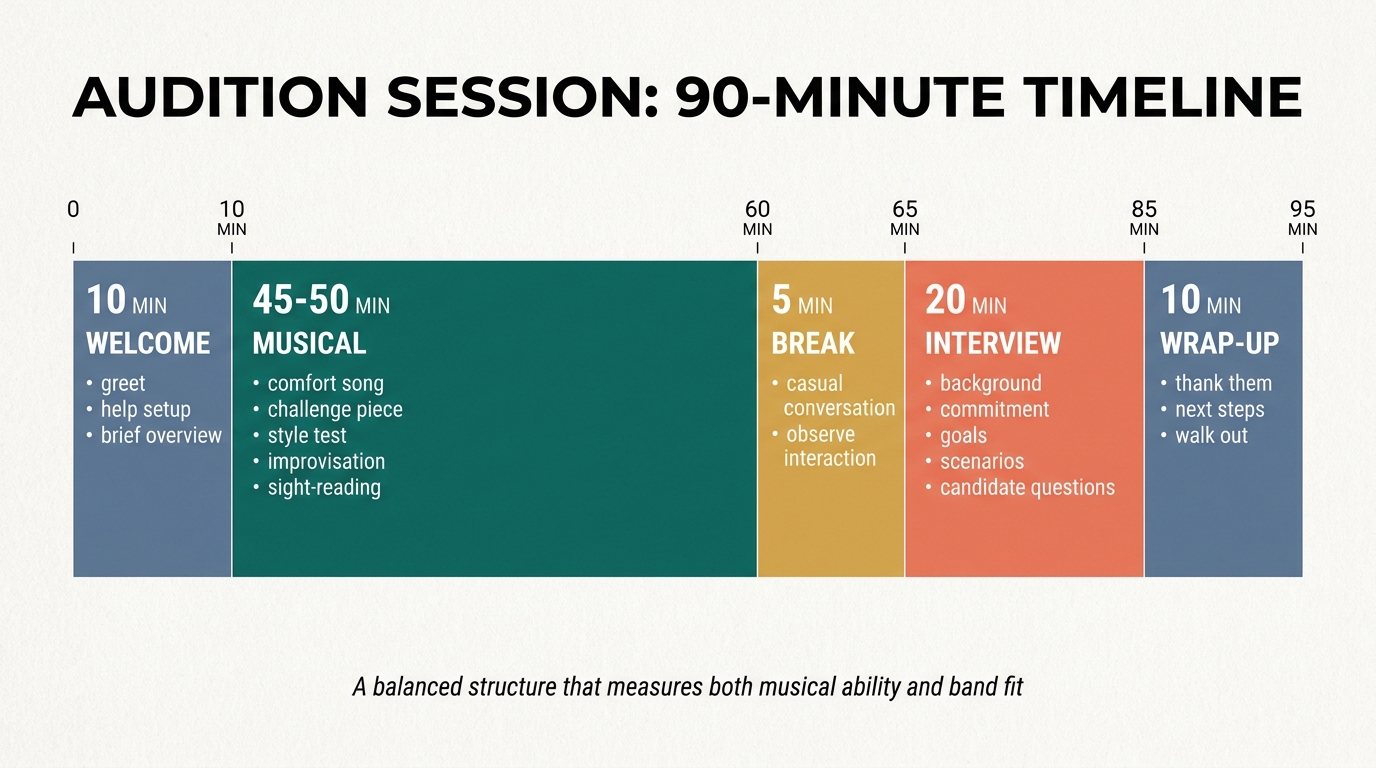
About 90 minutes works for most groups: short welcome, 45–50 minutes of playing, a break, a real interview, and a clean wrap with next steps. Shorter is fine for pure subs; longer only if you are testing a full set or second callback.
Should we weight personality as heavily as playing ability?
Yes for permanent seats. Technique without reliability, listening, or conflict skills breaks bands. Score both musical and interpersonal rubrics, then decide together—gut vibe alone without notes is how you forget who actually fit.
When is a second audition worth it?
When two candidates are close, you need more of your real repertoire, or a concern (timing, attitude, stamina) needs another look. Make the second session more like a real rehearsal: longer run, feedback, logistics talk—not just three more covers.
How fast should we follow up after someone auditions?
Aim for 3–5 days either with an offer, a callback, or a polite decline. If you are still seeing people, send a short “decision by date” note so strong players do not accept elsewhere while you ghost them.