
Onboarding Checklist
DOCX download
Onboarding Checklist
Free editable Word guide you can copy, fill in, and share with your band. Also readable on this page.
How to use this guide
Checklist for onboarding new band members. Tick the boxes with your host and the newcomer ends up holding access, files, money clarity, and a first-show plan.
Run it like this: the host ticks items off across the first month, the finished list lives in the shared drive, and the checklist restarts from the top each time a new member or sub joins.
The week someone accepts the seat is when culture is transferred—or chaos is. Onboarding is how access, expectations, and care become real.
Before the first full rehearsal
Before the debut full-band rehearsal, hand over calendar invites, the chart and lyric drive, pay-split basics, gear storage expectations, an emergency contact swap, and a map of where choices get announced. Musical learning can keep unfolding for months; operational fog should be gone by week one.
If the newcomer still cannot find Sunday's set list or the load-in hour without texting five people, the welcome process failed before note one. Everything a stranger needs should live in exactly two places, pinned in the chat and mirrored in the shared folder.
One host owns the checklist
Name one host, because a welcome owned by the whole band belongs to nobody and quietly dies. That person walks the newcomer through drives and norms, makes warm introductions at the first two rehearsals, and ticks each item off until nothing remains vague.
A sub hired for three dates needs the set, keys, call times, and pay terms — nothing more — while a full member also needs culture, voting customs, and the longer-range money picture. Say explicitly which track someone is on so nobody invents membership status midstream.
Done means independent
The process is finished when the newest member locates charts unaided, arrives at the right place ninety seconds early, and can explain the pay split and rehearsal norms to someone else — usually within three or four full run-throughs. Lingering dependence means a gap in the system, not a slow learner.
Say that graduation out loud, because independence is a system win worth naming, not merely a personality trait of the newcomer. A quick 'you are fully up to speed' at the end of month one retires the training wheels and resets how the room treats them.
Fill-in: Onboarding checklist
Host: ________
Access granted: ________
Files shared: ________
Money talk done?: ________
First show plan: ________
Putting it into practice
Assign a host and complete the checklist before the next full-band rehearsal with any new person.
FAQ
How long should new-member onboarding take?
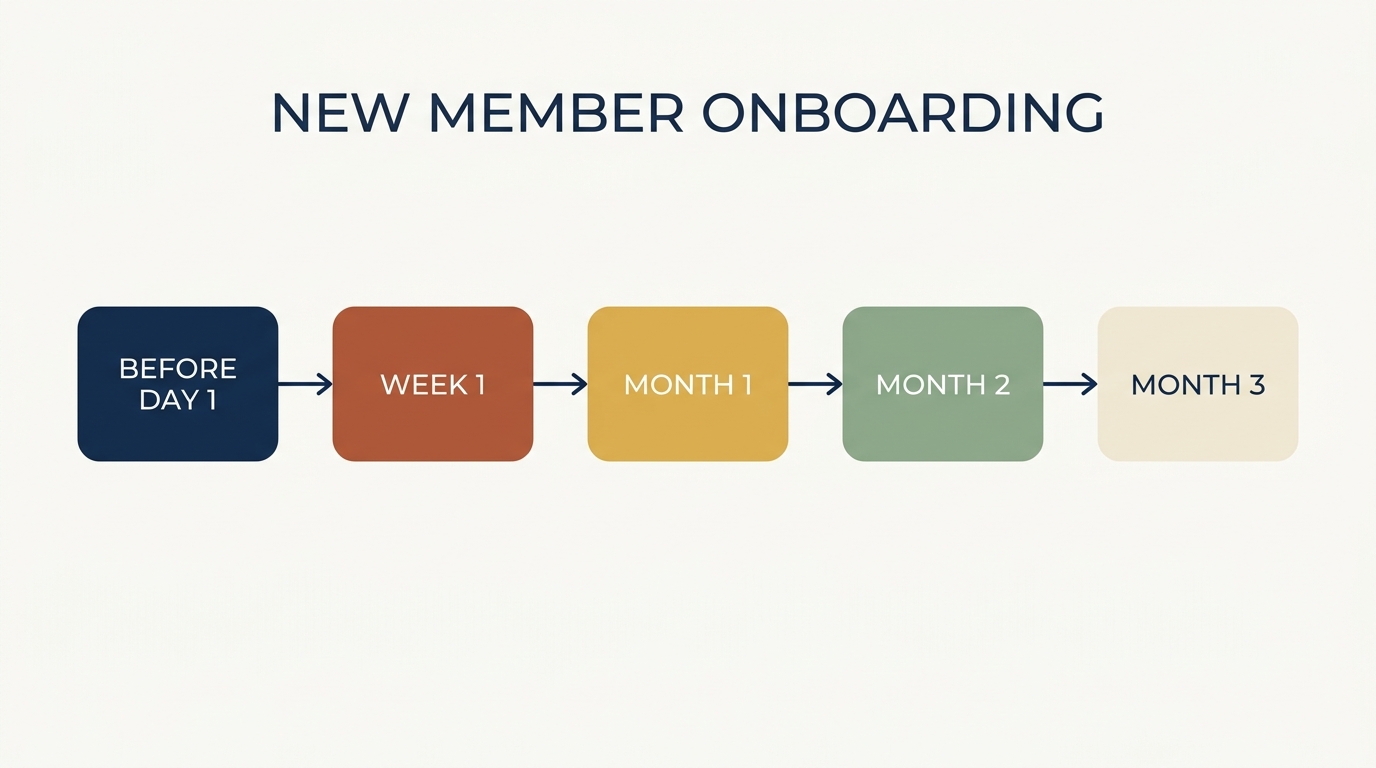
Plan for about 90 days: intense support in week one, weekly check-ins in month one, deeper ownership in month two, and a full review by month three. Chemistry and repertoire rarely fully settle faster without shortcuts that create silent resentment.
What should we hand a new member before day one?
Signed band agreement (or addendum), contacts and chat access, priority song list with recordings/charts, rehearsal logistics, upcoming shows, and how money works. Clear prep beats a surprise first rehearsal.
When should a new member play their first show?
When they know the set well enough to be solid under stress—not as a sink-or-swim test. Extra prep, stage layout talk, and a short post-show debrief protect both the band and their confidence; delay the debut if the set is still shaky.
What belongs in a 90-day review?
Mutual feedback: strengths, growth areas, fit with culture and commitment, and whether both sides still want the long-term seat. Celebrate the milestone, adjust expectations if needed, then treat them as a full member without perpetual “new person” status.