
Band Agreement Template
DOCX download
Band Agreement Template
Free editable Word guide you can copy, fill in, and share with your band. Also readable on this page.
How to use this guide
Comprehensive band agreement template with explanatory notes. Work clause by clause until the outline names members, the decision rule, the money split, IP ownership, and exit terms in plain language.
Suggested workflow: every member reads the outline alone, the group negotiates the money split and exit terms together, and the signed document gets reopened whenever someone joins, leaves, or income changes.
A band agreement is not about distrust. It is about clarity when money, masters, gear, and exits get real. Friendship is not a contract—and simple written rules protect friendships better than hopeful silence.
Why written agreements matter
When everyone already knows who decides, how income divides, and what happens if somebody quits, rehearsal energy goes into songs instead of re-litigating history. Informal arrangements hold right up until something valuable appears: a venue deposit, a studio bill, a tour offer, or a blow-up.
The document should stay short enough that busy musicians will genuinely read and sign it, which usually means three pages rather than ten. Any clause nobody intends to enforce should be cut, because empty toughness teaches the group to ignore the parts that actually matter.
Core sections every working band should cover
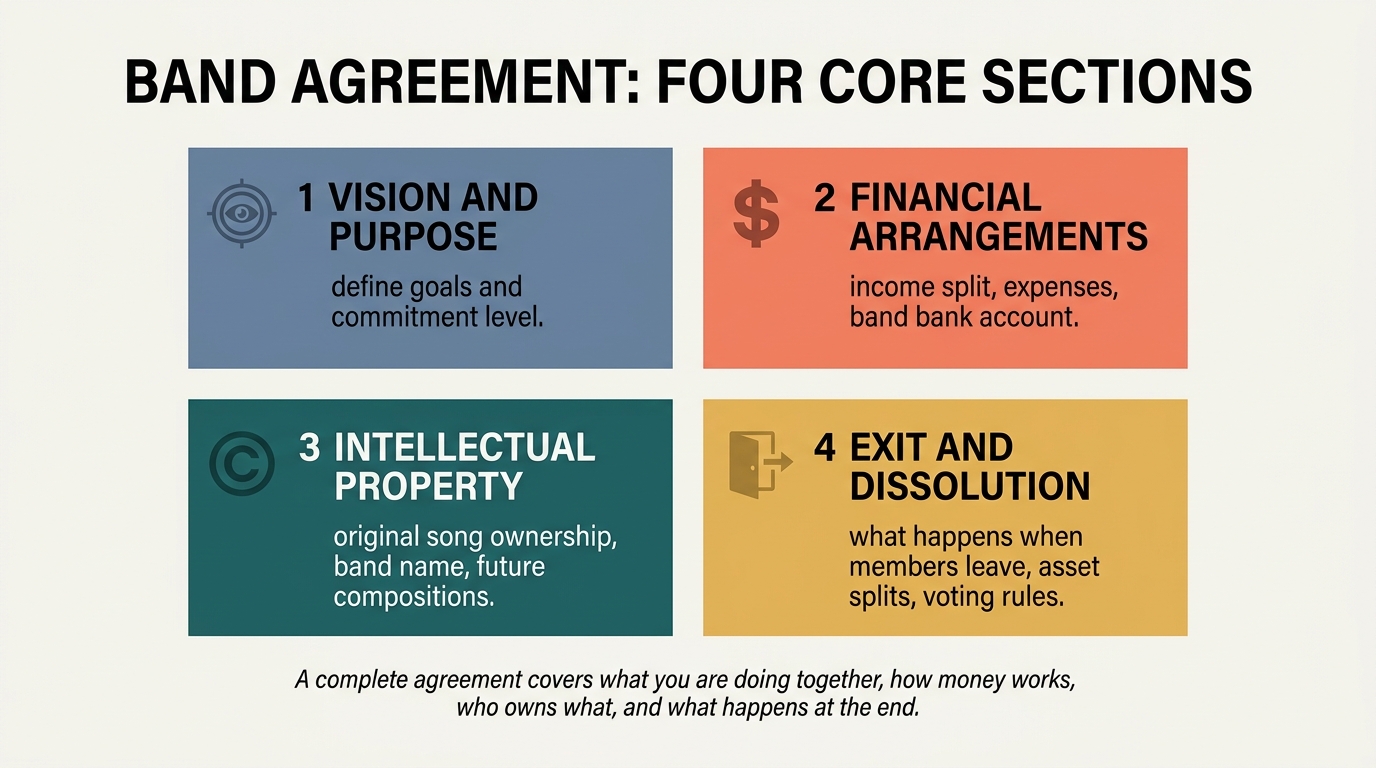
Name the project, the people, and their jobs first, then describe how deadlocked votes get resolved. Cover income division across gigs, merch, and recordings; who owns songs, masters, and the name itself; and the expectations around rehearsals and shows at a high level without turning the paper into a rehearsal schedule.
Finish with departure mechanics: how much warning a leaving player gives, what happens to their gear and any unpaid income, who keeps using the name, and what gets said publicly. A weekend four-piece needs two honest paragraphs here; a touring act that records needs more precision and probably professional review.
How to introduce paperwork without killing the vibe
Present the paperwork as respect rather than suspicion, and sign it before the first big expense or release, not after the first betrayal. A calm conversation in a good month costs an hour; renegotiating ownership mid-fight costs friendships and sometimes the catalog. Revisit it annually and whenever membership changes.
Keep the signed copy where more than one person can find it, and amend in writing when reality shifts: a new member, a new income stream, a new van. Templates are educational starting points, so have a music-aware attorney in your jurisdiction review anything involving serious money or intellectual property.
Fill-in: Agreement outline for our band
Members and roles: ________
Decision rule: ________
Money split model: ________
IP ownership notes: ________
Exit / notice terms: ________
Putting it into practice
Draft a one-to-three page agreement this month, get signatures, and store it with calendar and money access.
FAQ
When should a band create a written band agreement?
As early as you can: ideally when you form, add a member, record original music, or invest real money—not after a fight starts. Clarity while everyone is cooperative is cheaper than renegotiating under stress.
What sections matter most if we only have time for a short version?
Income and expenses, song and name ownership, decision-making, how members join or leave, and what happens if the band dissolves. Those five areas cause most breakups; expand the rest when you can.
Does filling out this template replace hiring a lawyer?
No. This is an educational starting point so you know what to discuss and document. Have a music-aware attorney review before you rely on signatures for IP, employment, or large investments—especially if laws in your location differ.
How do we handle the agreement when someone joins or leaves?
Require new members to sign (or a short addendum) before they are full partners, and follow the departure section for notice, buyouts, and IP. Review annually and whenever roles, income, or ownership change.